

Why Humanizing AI Content Matters More Than Ever
AI tools like OpenAI’s GPT models have completely changed how we make content. They help you get drafts done fast, get more out the door, and even spark fresh ideas. But speed alone? That doesn’t build trust.
People connect with content that feels clear, honest, and real.
Cognitive psychology tells us that warmth and competence matter a lot in how people respond. Social perception theory, a big topic in behavioral science, backs this up: Trust builds when communication actually feels human, transparent, and purposeful.
AI can give you facts and correct phrasing, sure.
But people write in ways that persuade, comfort, and connect.
If your content sounds flat, robotic, or churned out by a machine, readers zone out. Even Google rewards content that ticks the E-E-A-T boxes: Experience, Expertise, Authoritativeness, Trustworthiness.
Humanizing AI isn’t about hiding the fact that you used a tool.
It’s about making the final result better, elevating it.
What Does "Humanized Content" Actually Mean?
Humanized Al content isn't just grammatically correct. It
- Feels natural, like an honest conversation
- Shares real experiences or actionable tips
- Shows awareness of who's reading and what they care about
- Uses lively, specific language instead of bland generalizations
- Actually demonstrates expertise
It’s not about stripping out structure. It’s about adding depth, personality, and intention.
When you balance hard facts with that human touch, people pay attention and remember what you say.
The Science Behind Human Communication
Linguistics and psychology research highlight three big ideas:
- Be specific. Generic statements drain trust.
- Tap into emotion. Emotional language sticks in the brain; science even shows it fires up our memory.
- Tell stories. Stories make information easier to understand and recall.
Al usually misses these magic touches unless you step in.
Humanizing means you intentionally build in these principles, turning functional drafts into content that connects.
Step-by-Step Framework to Humanize Al-Generated Content
1. Start With Real Human Intent
Before you polish anything, ask yourself:
- Who am I writing for?
- What's weighing on them right now?
- What do they hope changes?
- How do they feel as they read?
Empathy carries the message.
Don't say: "Al tools improve productivity."
Try: "If deadlines stress you out, Al tools can ease that pressure so you can focus on what actually matters."
Intent shifts the tone.
2. Trade Generic for Specific
Al spits out safe, broad stuff. Replace it.
Weak: "Many businesses use Al."
Strong: "Marketing teams use Al to draft blog posts, write ad copy, and analyze results in minutes, not hours."
Being specific shows you know the details.
3. Layer in Emotional Depth
Emotion isn't hype. It's noticing what people care about.
Add words that bring confidence, relief, focus, or energy.
- Proven
- Transformative
- Actionable
- Reliable
Use these when it fits, especially in headlines or transitions, but not everywhere.
Emotion sets things in motion.
4. Mix Up Sentence Rhythm
Al lines often sound the same. People write with variety:
Short sentence. Long, thoughtful explanation. Bold suggestion.
That natural flow keeps readers engaged.
5. Ground Claims in Real-World Context
Authority grows when you point to real research or standards.
Example: Stanford's Human-Centered Al Institute pushes for responsible innovation. Google Search Central emphasizes helpful, user-first content.
Mentioning respected sources shows you're not just making things up.
6. Be Transparent About Al Use
Let readers know if Al helped with drafting and that a human shaped the final piece. Honesty earns trust and supports E-E-A-T.
People appreciate knowing where their information comes from.
7. Use an Editing Routine
Editing changes everything. Use a quick checklist:
- Cut the repeats
- Make complicated things simple
- Add concrete examples
- Smooth out rough spots
- Match the tone to the audience
- Double-check facts
- Strengthen the open and close
That's how you transform text into something memorable.
How an Al Humanizer Tool Solves the Problem
Manual editing can get you there, but it eats up time, especially if you publish a lot.
That's why a tool like an Al Humanizer helps. It's built specifically to turn Al drafts into smoother, more natural, and engaging content quickly.
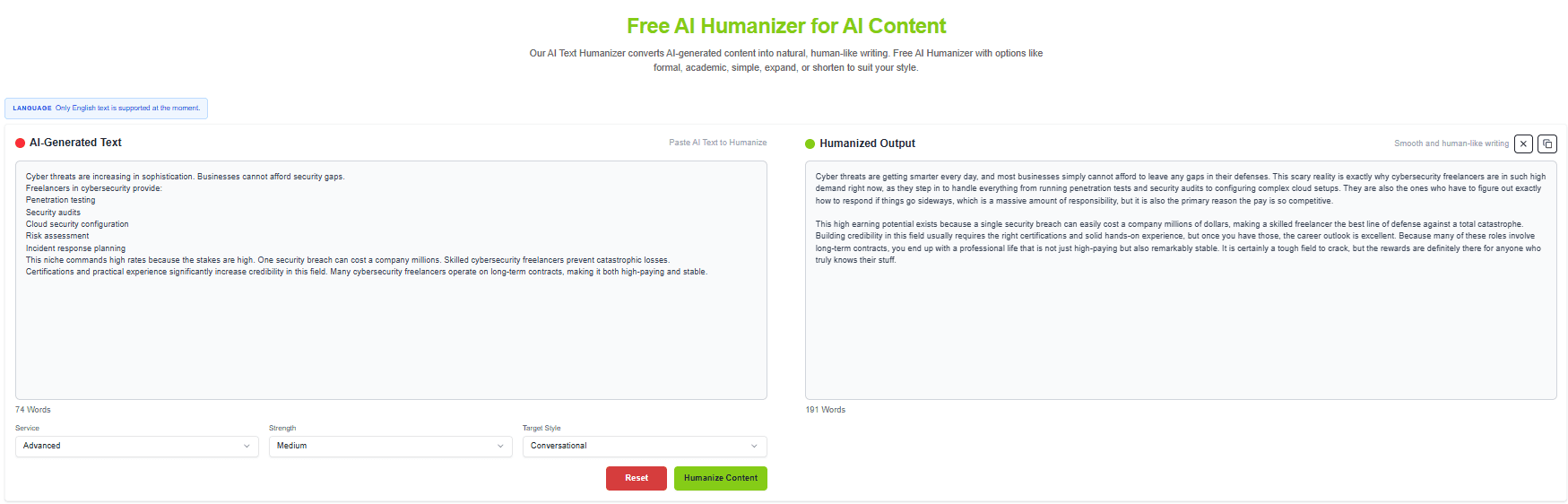
You can:
- Pick your editing style: Enhanced, Gemini, Advanced
- Set how strong the rewrite is: Light, Medium, Strong
- Set a tone: Conversational, Professional, Academic, Creative
With smart tools, you can keep your main ideas, fine-tune the emotional layer, clean up awkward lines, and speak in a voice that fits your audience.
It's not about self-promotion. It's about clarity and confidence.
When you need reliable results without second-guessing, an Al Humanizer keeps consistency, quality, and your message intact.
Optimizing Humanized Content for Search and Al Engines
Search engines want content that's clear and genuinely helpful.
So:
- Address what the reader really wants to know. Skip keyword stuffing.
- Use clear, direct headings that help readers (and search engines) navigate.
- Cover your topic fully, but keep it focused.
- Show your authority by referencing trusted sources.
- Prioritize readability: short paragraphs, a logical flow, no fluff.
Human-first writing performs better because it serves real people, not just algorithms.
Common Mistakes When Humanizing Al Content
Watch out for:
- Overediting until you lose meaning or clarity
- Piling on emotions at the expense of facts
- Skipping fact-checks
- Deleting structure and making things messy
- Hiding Al use instead of being honest
Humanizing is about refining, not distorting, the message.
How Experts Humanize Al Content
Top writers and editors use a layered approach:
- Draft with Al
- Review for facts and fit
- Inject domain insight
- Tune the tone for the audience
- Back up claims with sources
- Pass through one last time for authenticity
This blend delivers quality and speed and aligns with what major organizations recommend for responsible Al use.
Al speeds things up. Humans lift content higher.
Building Trust Through E-E-A-T
To show true expertise and trustworthiness:
- Put author info up front
- Explain the review process briefly
- Cite reputable sources
- Use secure website tech (like HTTPS)
- Offer easy ways for readers to contact you
Every little signal adds up to convince readers they're in good hands.
A Practical Example: Before and After
Al Draft: "Al content tools are useful for businesses because they save time."
Humanized: "If your team struggles to publish regularly, Al tools can cut drafting time in half so you spend less time writing and more time shaping creative strategy."
The second version:
- Identifies a real-world pain point
- Suggests a transformation
- Feels supportive and actionable
That's the difference humanizing makes.
Frequently Asked Questions (FAQs)
How do I know if my Al content sounds robotic?
Check for repetitive phrases, generic claims, same-length sentences, and lack of examples. If it seems bland or emotionless, it needs more of a human touch.
Does Google penalize Al-generated content?
Google cares most about quality and usefulness. Content that's thin, repetitive, or lacks credibility won't rank well no matter how it was made.
Is it ethical to use Al for content writing?
Yes, if you're transparent, you fact-check, and you add a human layer before publishing.
How much editing does Al content usually need?
Depends on the topic. Technical material often needs a deep review by an expert. Simpler topics might just need a quick tone edit.
Can an Al Humanizer keep my meaning intact?
Yes, when it's designed well. Features that let you control rewrite strength and style help maintain your main ideas while removing the "robot feel."
Conclusion: Turn Al Speed Into Human Connection
Humanizing Al content isn't about hiding tech; it's about earning trust and actually connecting with readers.
Al gives you speed and structure. But what readers remember is the clarity, empathy, and trust in your words. When you add a human perspective, check your facts, and match your tone to what your audience needs, you lift your content from just words on a page to something that matters.
Search engines reward genuine, people-first writing, and so does your audience. By blending smart Al tools like Smooli Al with thoughtful editing, you transform rapid drafts into real communication that sticks.
The trick is to let Al supercharge your process and let human insight guide the story. That's how you turn good content into great conversations.