

Introduction
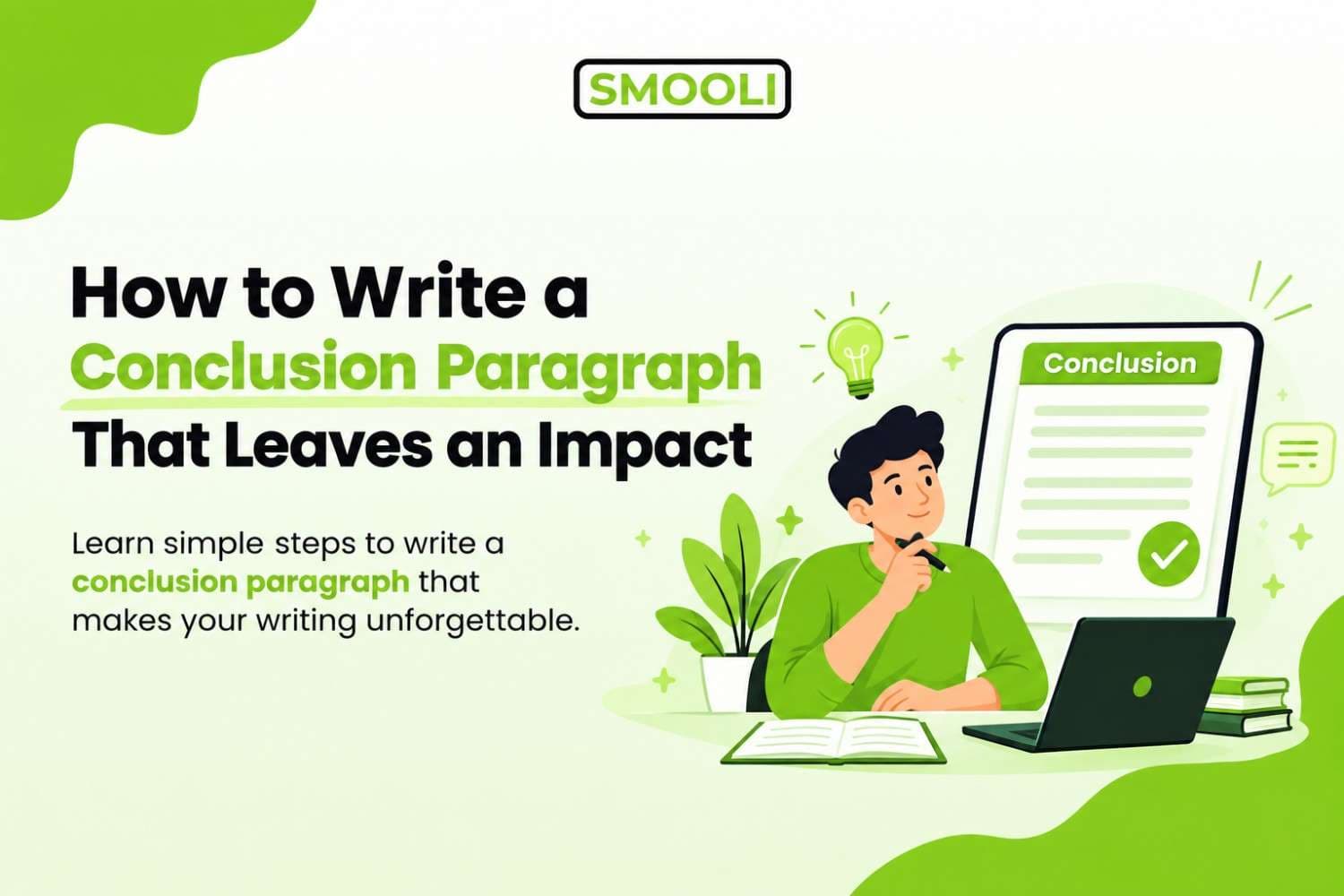
If you want to know how to write a conclusion paragraph, start by restating your main idea in fresh words, briefly summarizing your key points, explaining why they matter, and ending with a strong final thought. A good conclusion should bring your writing to a clear close without introducing a completely new argument or repeating the entire essay.
In this guide, you'll learn how to write a conclusion paragraph step by step, with simple techniques, examples, common mistakes to avoid, and practical tips for creating a conclusion that leaves a lasting impact. You'll also learn how AI writing tools can help when you're struggling to find the right words.
What Is a Conclusion Paragraph?
A conclusion paragraph is the final paragraph of an essay, article, report, or other piece of writing. Its main purpose is to bring the discussion to a natural end.
The conclusion usually reminds readers of the main argument or topic, summarizes the most important points, and provides a final thought. It should make the reader feel that the subject has been properly addressed.
A conclusion does not need to be long. In many cases, one well-written paragraph is enough. What matters most is that the paragraph clearly connects with the ideas discussed earlier.
For example: if your essay explains why regular exercise is important, your conclusion could briefly restate the main benefits, such as better physical health, improved mood, and increased energy. You could then end by encouraging readers to make physical activity part of their daily routine.
Why the Conclusion Paragraph Matters So Much
Think about the last time you read an article, watched a movie, or listened to a story. Chances are, the ending shaped how you felt about the whole experience. Writing works the same way.
A conclusion paragraph does three important jobs:
- It reminds the reader what the piece was about.
- It ties together the main points into one clear takeaway.
- It leaves the reader with something to think about, feel, or act on.
Without a solid conclusion, even the most well-researched essay or the most engaging blog post can fall flat. Readers are left wondering, "So what? Why did this matter?" A good ending answers that question before they even ask it.
This is true whether you're writing a school essay, a business report, a persuasive article, or a piece of content marketing. The conclusion is your final chance to make an impression, so it's worth getting right.
How to Write a Conclusion Paragraph Step by Step
Learning how to write a conclusion paragraph becomes much easier when you follow a simple structure.
A useful conclusion generally has three main parts:
- Restate the main idea
- Summarize the key points
- End with a final thought
Let's look at each step in detail.
1. Restate Your Main Idea
The first step is to remind the reader about the main argument, thesis, or purpose of your writing. However, do not copy your introduction word for word. Instead, express the same idea using a different language.
For example, suppose your essay discusses the benefits of reading:
Introduction thesis: "Reading regularly improves vocabulary, strengthens concentration, and helps people develop a deeper understanding of the world."
A conclusion could restate the idea like this: "Regular reading offers much more than entertainment. It can strengthen important mental skills while helping people expand their knowledge and understanding."
The message remains similar, but the wording is different.
This technique helps remind the reader of the main point without making your conclusion sound repetitive.
2. Summarize Your Main Points
After restating your main idea, briefly bring together the most important points from your essay.
You do not need to explain every detail again. Instead, focus on the ideas that support your central argument.
For example, if your essay explains why students should develop good study habits, your conclusion might mention:
- Better time management
- Improved concentration
- Less academic stress
- More consistent performance
You can combine these ideas into one or two sentences rather than creating another long explanation.
Remember that a conclusion is a summary, not a second body section.
3. Explain Why the Topic Matters
A powerful conclusion often answers the question, "Why does this matter?" This gives your ending more meaning.
For example, instead of ending with: "Therefore, students should develop better study habits."
You could write: "By developing consistent study habits, students can manage their workload more effectively and build skills that benefit them far beyond the classroom."
The second version gives the reader a reason to care about the topic.
4. End With a Strong Final Thought
The final sentence is often the most memorable part of your conclusion.
You can finish with:
- A recommendation
- A prediction
- A call to action
- A broader observation
- A meaningful statement
- A question for further thought
For example: "Small improvements in daily study habits can create lasting benefits for both academic success and personal growth."
The goal is not to sound dramatic. The goal is to give the reader a satisfying ending.
The Common Mistakes People Make When Writing Conclusions
Before we get into how to write a great conclusion, let's look at what usually goes wrong. Recognizing these mistakes will help you avoid them in your own writing.
- Simply repeating the introduction word for word: Many writers think a conclusion just means copying the intro and swapping a few words. This feels lazy to readers and adds no real value.
- Introducing brand-new information: A conclusion isn't the place to bring up a new argument, statistic, or idea. That belongs in the body of your writing. Save your ending for wrapping things up, not opening new doors.
- Being too short or too vague: Some writers rush the ending because they're tired or running out of time. A one-line conclusion rarely does justice to a well-developed piece of writing.
- Ending on a weak or uncertain note: Phrases like "In conclusion, this topic is important" don't leave much of an impression. Readers want confidence and clarity, not filler.
- Forgetting the reader entirely: A good conclusion speaks directly to the reader, telling them what they should think, feel, or do next. Ignoring this connection makes the ending feel cold and disconnected.
If any of these sound familiar, don't worry. The good news is that a strong conclusion follows a fairly simple formula once you understand the structure.
Conclusion Paragraph Examples for Different Types of Writing
The best conclusion depends on the type of writing, your audience, and the purpose of your content. While every conclusion should bring your ideas together, the tone and structure may vary.
Academic Essay
Restate your main argument in a fresh way and highlight its broader significance. Keep the tone formal, clear, and analytical while showing why your argument matters.
Blog Post
End with a friendly and engaging summary of your main points. You can also include a simple call to action, such as asking readers to share their thoughts, leave a comment, or try what they have learned.
Business Report
Keep the conclusion clear, concise, and focused on action. Summarize the key findings and provide practical recommendations or next steps based on the information presented.
Persuasive Writing
Reinforce your main position with confidence and leave readers with a strong final thought. A powerful conclusion can encourage readers to agree with your viewpoint or take action.
Story or Narrative
Focus on resolving the main conflict and providing a satisfying emotional ending. A strong narrative conclusion should connect the ending to the story's central themes or character development.
Choosing the right conclusion style helps you end your writing with purpose. Consider your audience, topic, and goal to create a final paragraph that feels natural, meaningful, and complete.
Can an AI Conclusion Generator Help?
Writing a conclusion from scratch can sometimes be difficult, especially when you already know what you want to say but cannot find the right words.
An AI conclusion generator can help you turn your main ideas into a clear conclusion. It can provide a starting point, suggest different ways to summarize your argument, and help you organize the final paragraph.
For students, bloggers, content writers, and professionals, an AI tool can be useful when they are dealing with writer's block or need to create several versions of a conclusion.
If you want to create a conclusion quickly, try our AI Conclusion Generator. You can provide your topic or existing content and use the generated result as a starting point for your own writing.
The goal should not be to blindly copy AI-generated text. Always review the result, check that it accurately represents your ideas, and make changes where necessary.
How Long Should a Conclusion Paragraph Be?
There is no single word count that works for every conclusion. The ideal length depends on the overall length and complexity of your writing. For a short essay, a conclusion may only need three to five sentences. For a longer research paper, the conclusion may contain several paragraphs.
A useful rule is to make the conclusion long enough to:
- Restate the main argument
- Summarize key points
- Explain the significance
- Provide a final thought
Avoid adding unnecessary sentences simply to make the conclusion longer. A short, meaningful conclusion is better than a long conclusion filled with repetition.
Frequently Asked Questions
1. How do you write a good conclusion paragraph?
To write a good conclusion paragraph, restate your main idea in different words, summarize the key points, explain why they matter, and finish with a strong final thought.
2. How long should a conclusion paragraph be?
A conclusion paragraph is usually around 3-5 sentences for a standard essay, but its length can vary depending on the overall length and purpose of the writing.
3. What is the difference between a summary and a conclusion?
A summary mainly reviews the important points, while a conclusion goes further by bringing those points together, reinforcing the main idea, and explaining why the topic matters.
4. Will using a conclusion maker hurt my writing skills?
Not if you use it thoughtfully. Treat generated conclusions as a starting draft rather than a finished product. Reading, editing, and personalizing AI-generated text actually helps you notice patterns in strong writing, which can improve your own instincts over time.
5. Can I ask a question in my conclusion paragraph?
Yes, absolutely. A thoughtful, open-ended question can be a powerful way to end a piece, especially for blog posts or persuasive writing. Just make sure the question feels like a natural extension of your main argument, not a random add-on.
6. What is a conclusion maker?
A conclusion maker is a tool that helps users create a final paragraph for essays, articles, reports, and other types of writing. It can help organize key ideas into a clear ending.
Final Thoughts
A good conclusion paragraph is more than just the last part of your writing. It is your final chance to remind readers of your main idea and leave them with a clear and meaningful message.
To write a strong conclusion, restate your main idea in fresh words, briefly review your key points, and finish with a thoughtful final statement. Keep it clear, simple, and connected to the rest of your writing.
If you are having trouble finding the right words, an AI tool can give you a useful starting point. Smooli's AI Conclusion Generator can help you create conclusion ideas quickly, which you can then review, edit, and personalize to match your own writing.