

Introduction:
Al has quickly become part of everyday student life. From understanding a difficult math problem to researching an assignment, improving an essay, creating presentations, and turning lecture notes into study material, the right Al tool can save hours of work. But there is one problem: there are now hundreds of Al tools claiming to be useful for students.
Which ones are actually worth using?
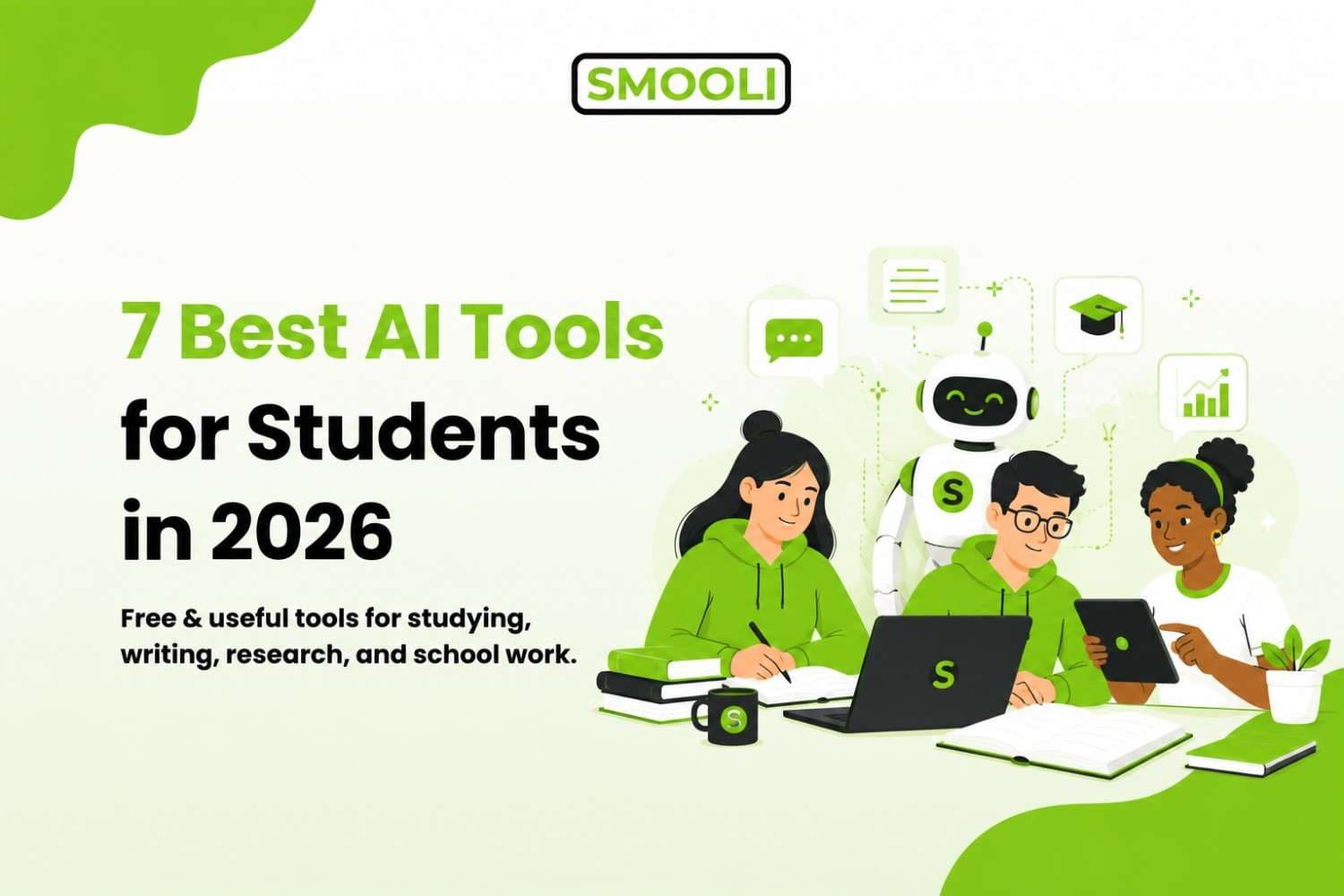
The best Al tools for students in 2026 are ChatGPT, Google Gemini, NotebookLM, Perplexity, Grammarly, Canva, and Smooli Al. Each tool solves a different student problem, such as studying, research, writing, presentations, file management, or everyday academic tasks.
Some are completely free, while others provide useful free plans with optional paid upgrades. More importantly, good Al for students should not simply complete homework for you. The best tools help you understand subjects, organize information, improve your own work, and spend less time on repetitive tasks.
Best Al Tools for Students 2026: Quick Comparison
| Al Tool | Best For | Free Option? | Ideal Student Use |
|---|---|---|---|
| ChatGPT | Overall learning and tutoring | Yes | Explanations, brainstorming, studying |
| Smooli Al | Free everyday student utilities | Yes | Writing, PDFs, OCR, file conversion |
| NotebookLM | Studying your own course material | Yes | Notes, PDFs, study guides |
| Perplexity | Research and finding sources | Yes | Essays, reports, fact-checking |
| Grammarly | Academic writing | Yes | Grammar, clarity, editing |
| Canva | Presentations and visual projects | Yes | Slides, posters, assignments |
| Google Gemini | Schoolwork and multimodal learning | Yes | Homework, images, documents, research |
For example, NotebookLM is excellent when you want to study directly from lecture notes and PDFs, while Perplexity is more useful when you need to research information from the web. Grammarly is stronger for polishing an essay, while Canva is better when the assignment requires slides or visual design.
Students who regularly need smaller tools for writing, document conversion, OCR, and other everyday tasks can also explore the collection of free Writing tools on Smooli Al.
Now let's go through each one in detail.
1. ChatGPT - Best Overall Al for Students
ChatGPT remains one of the most flexible Al tools a student can use in 2026. Instead of being limited to one academic task, it can work as a tutor, brainstorming partner, writing assistant, research helper, coding assistant, or revision tool.
One particularly useful feature for students is Study Mode. Rather than immediately giving you an answer, Study Mode can guide you through a problem, ask questions, explain concepts in stages, check your understanding, and create practice questions.
OpenAl says Study Mode is available across ChatGPT plans and can work with uploaded class notes, worksheets, slides, PDFs, textbook excerpts, and images when uploads are available.
Why ChatGPT Is Useful for Students
Imagine you are learning quadratic equations but do not understand why a particular formula works.
Instead of asking:
"Give me the answer."
Try:
"Teach me how quadratic equations work like I am a beginner. Give me one example at a time and ask me a question before moving to the next step."
2. Smooli Al - Best Free Al Toolkit for Everyday Student Tasks
Students often need tools that have nothing to do with asking a chatbot a complicated question.
You may simply need to:
- Convert a PDF into Word
- Extract text from a photo
- Improve a paragraph
- Create a conclusion
- Merge documents
- Compress a file
- Refine Al-generated wording
Instead of opening a separate website for each small task, Smooli Al brings dozens of Al, writing, file, productivity, and web utilities into one platform. Smooli currently describes its platform as offering more than 60 tools for students, creators, and professionals.
Useful Smooli Tools for Students
One common student problem is receiving course material as a PDF when you need an editable document. The PDF to Word converter can help convert PDF documents into editable Word files.
Another common problem is having notes inside screenshots, scanned worksheets, or photos. Instead of typing everything manually, students can use the image-to-text OCR tool to extract editable text from images.
Smooli also provides an Al Humanizer designed to improve clarity, flow, tone, and readability in Al-assisted text. Students should use tools like this for legitimate editing and readability improvements, not to disguise prohibited Al use or bypass academic integrity rules.
3. NotebookLM - Best Al for Studying Notes and PDFs
NotebookLM solves a different problem from general Al chatbots. Instead of primarily answering questions from general knowledge, NotebookLM lets you create a notebook based on the sources you provide.
You can add materials such as PDFs, websites, Google Docs, Google Slides, audio, YouTube videos, and other supported sources. NotebookLM can then answer questions using those materials and provide citations back to the source.
That makes it particularly useful for college and university students.
Example
Suppose your professor gives you:
- Six lecture PDFs
- Two research papers
- A 70-page study guide
- Several presentation slides
You could add those materials to NotebookLM and ask: "What are the five most important concepts I should understand before my exam?"
You could then ask:
"Create 20 practice questions using only these sources."
Because its responses are grounded in your selected material, it can be easier to trace where information came from. NotebookLM can also transform sources into formats such as study guides, briefings, mind maps, and Audio Overviews.
4. Perplexity - Best Al Tool for Student Research
Research is one area where students need to be especially careful with Al. A chatbot can provide a convincing answer even when some details are wrong. When writing an academic report, you need to know where information came from.
That is where Perplexity becomes useful. Perplexity combines Al-generated answers with web research and source references, making it easier to investigate a question and then visit the underlying sources yourself.
How Students Can Use Perplexity
Suppose your assignment is: "How is artificial intelligence changing higher education?"
Instead of asking an Al tool to write the full essay, use Perplexity to investigate questions such as:
"What recent research examines generative Al use among university students?" Then open the sources, read them, and build your argument.
You can use it for:
- Discovering sources
- Researching current topics
- Comparing viewpoints
- Finding statistics
- Fact-checking claims
- Building an initial reading list
- Exploring unfamiliar subjects
Perplexity also provides a Research mode for deeper research tasks. Free users receive limited access, while paid plans provide extended usage. Student-focused Education Pro options and learning features are also available for eligible verified users.
5. Grammarly - Best Al for Student Writing
This is Best for: Essays, grammar, proofreading, clarity, academic writing. Even when you understand your topic, writing clearly can be difficult. That is why Grammarly remains useful for students.
It can review writing for grammar, spelling, readability, clarity, structure, and tone while working across many of the apps students already use. Grammarly also offers student-focused features related to writing feedback, citations, originality, and Al-assisted writing.
How to Use Grammarly for School
The strongest use case is editing something you already wrote. For example, write your essay first and then use Grammarly to identify:
- Grammar mistakes
- Confusing sentences
- Wordy paragraphs
- Awkward phrasing
- Tone problems
- Punctuation errors
This preserves your ideas while helping improve the final presentation. Grammarly's current free Al writing assistant also includes a limited monthly allowance of generative Al prompts, while paid plans provide higher allowances and more advanced functionality.
6. Canva - Best Al for Presentations and School Projects
Not every assignment is an essay. Students regularly need to create:
- Presentations
- Posters
- Infographics
- Project reports
- Videos
- Portfolios
- Resumes
- Group assignments
For visual work, Canva is one of the most practical tools available. Its student-focused platform includes presentations, documents, whiteboards, videos, templates, collaborative tools, and Al-assisted design features.
Why Canva Is Useful for Students
Suppose you have to give a 10-minute presentation about climate change. You may already have good research, but turning a blank presentation into attractive slides can take a long time.
Canva can help you organize visual elements, choose layouts, create graphics, and improve the overall presentation of your work. It is especially useful for group assignments because multiple students can collaborate on designs.
7. Google Gemini - Best Al for School Work
If you are searching for the best Al for school work, Google Gemini deserves a place near the top of the list.
Gemini can answer questions, explain topics, brainstorm ideas, analyze documents and images, and help students work through academic material. Google also provides Guided Learning, which is designed to make Gemini behave more like a tutor. Students can ask questions while receiving step-by-step explanations, visual support, and learning guidance instead of only getting a finished answer.
Best Al for School vs. Best Al for College Students
The right Al depends partly on your level of education.
Best Al for School Students
For everyday school work, a useful combination is:
ChatGPT or Gemini + Canva + a utility platform such as Smooli Al.
ChatGPT and Gemini can explain concepts and help you study.
Canva can turn your ideas into presentations and visual projects.
Smooli can handle smaller tasks such as document conversion, OCR, and writing utilities.
Best Al for College Students
College and university students usually deal with more research papers, PDFs, citations, long readings, and independent study.
A useful stack is:
NotebookLM + Perplexity + ChatGPT + Grammarly.
NotebookLM helps you study your course materials.
Perplexity helps discover external information and sources.
ChatGPT can explain difficult ideas.
Grammarly can help polish your final writing.
That combination covers most research-heavy university workflows without forcing one tool to do everything.
Frequently Asked Questions About Al for Students
1- What is the best free Al for students?
There is no single best free Al for every student. ChatGPT is one of the best general-purpose options, NotebookLM is excellent for studying source material, Perplexity is useful for research, and Smooli Al is useful for free everyday writing and file utilities.
2- Is Smooli Al free for students?
Yes. Smooli Al's tools, including the Al Writing & Content Tools and File & Media Converters, are free to use and don't require creating an account, making it a convenient option for students who need quick help without extra sign-up steps.
3- What is the best Al for school?
ChatGPT and Google Gemini are two of the best options for school students because they can explain subjects, answer questions, work with learning materials, and provide step-by-step assistance.
Final Thoughts: Which Al Tool Should You Use?
The best Al tools for students in 2026 are not necessarily the tools that generate the longest answers or promise to complete assignments instantly. The most useful tools are the ones that make learning easier while keeping the student in control. Start with ChatGPT or Gemini if you need a general Al learning assistant.
Use NotebookLM when you need to understand your own class material. Choose Perplexity for research, Grammarly for writing, and Canva for visual assignments. And when you need quick tools for documents, writing, OCR, PDFs, or everyday digital tasks, explore the free tools available on Smooli Al.